Tincture Journal is seeking poetry for Issue 17 (March 2017).
Submissions (via Submittable) will close 31st January.
Poet

Tincture Journal is seeking poetry for Issue 17 (March 2017).
Submissions (via Submittable) will close 31st January.
Huge thanks to writer Nigel Featherstone for including Glasshouses in his ‘Good reading of 2016’.
Chuffed, and sinking deeper into my summer reading chair …
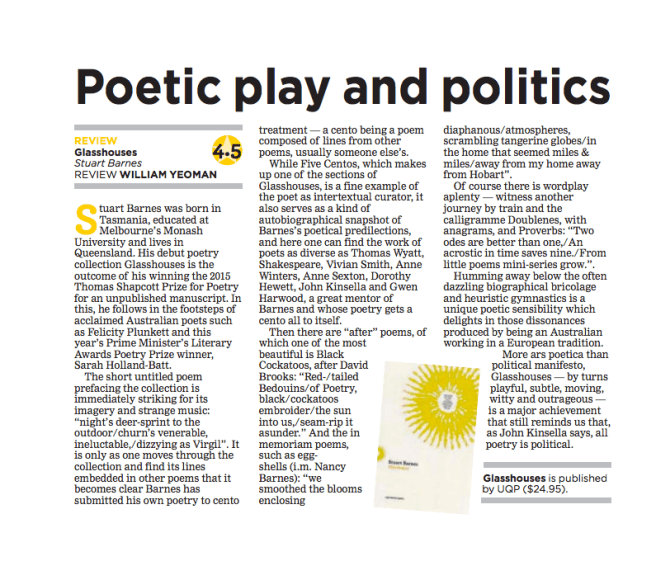
Very grateful to William Yeoman for his thoughtful, generous piece on Glasshouses which appeared in The West Australian, 29th November 2016.
From William’s 4.5 of 5 stars review:
‘Humming away below the often dazzling biographical bricolage and heuristic gymnastics is a unique poetic sensibility which delights in those dissonances produced by being an Australian working in a European tradition. More ars poetica than political manifesto, Glasshouses — by turns playful, subtle, moving, witty and outrageous — is a major achievement that still reminds us that, as John Kinsella says, all poetry is political.’
Glasshouses was launched by brilliant poet Matt Hetherington on Saturday 27th August at The Judith Wright Centre of Contemporary Arts as part of Queensland Poetry Festival 2016.
Matt’s launch speech is reproduced below.
•
In his essay, ‘The Great Reducers’, the French thinker Maurice Blanchot suggests that a writer cannot accept distinction, cannot be distinguished. He writes ‘To punish him, that is, to reward him by having him enter the elite of writers [is then to make] him accept the idea of an elite in which the truth of writing, which tends toward an essential anonymity, is lost. […] It is up to literature – to poetry – to put forward an experience of [profound questioning]…an experience such that we are put to the test of the absolutely other, of that which escapes unity.’ [Friendship, p. 63, 65, my under-linings, translated by Elizabeth Rottenberg.]
Is there another poetry collection published in Australia that so generously embraces the Other in all its variety, and which seems to seek such anonymity, and to strive towards an escaping from unity? Of all the qualities in this book, this largeness – this paradoxical humility – may be the central one, and that last year’s Thomas Shapcott Award should be given to it only serves, I think, to magnify and promote that particular quality. Having said that, there are a number of superb autobiographical poems in here, but these all elaborate on the multiple selves within the self…or as Stuart puts it, ‘Paranoid / even kin will taste your heart / beat uhth-er uhth-er’ [‘In a Beautiful Place Out in the Country’].
Under the ever-increasing warmth of the Green house Effect, we all live in glass houses, and as the work subtly reminds us, people in glasshouses should not throw stones, so perhaps the open-heartedness and democratic gentleness exemplified here is one of the best ways to minimize our ever-increasing hypocrisy. These pages glow with a deep appreciation of both famous and less-known folk; there are many, many lines interspersed from other sources, particularly from literature, pop music and cinema, and every second piece is either dedicated to someone, or a poem written ‘after’ another poet. [He even re-uses lines from his own poems in the book’s opening ‘Proem’.] This celebration of intertextuality, a ‘sampling’ and ‘remixing’ of others, whether in centos or not, supplies an energy that is equal parts instructive and provocative. Just like people in the world, you won’t love every poem in here, but you’re not meant to. What can occur after repeated readings, though, is that one sees that each poem has its own logic (or ill-logic), and its own seductive details, one of the more technically outrageous examples being the rhyming of ‘ghazal’ with ‘HAHA’.
Glasshouses is itself like a glasshouse; a transparent, vivid birthplace, where succulent, colourful language grows into unique, multifaceted life. There are a number of different varieties of sonnets, at least one villanelle, a senryu, a selection of proverbs, five centos or more, and a Post-Modern Baroque Double Acrostic which ends the book with these lines: ‘extensive fields: white spaces: the place where / chaos yields to order, where clouds are formed.’ There are also forms that I don’t know the name of, or that have been cooked up by – as he refers to himself –‘Stew-art’.
Just to finish, I want to give a brief example of the intelligence and linguistic playfulness in here:
‘… a song
voodooing headphones
(helical strings, apocalypse-vox), a doozy
: you glide over gravel like Marie Laveau,
or the way your physio’s fingers glide over breastbones,
ladders to out-of-whack clavicles (‘A brunette Chantoozie
once shouted me a bottle of red from Bordeaux’),
hook a left into the main drag,
pass the newsagency that doesn’t sell
The Australian or NME
(‘Sooky fag.
Go back to Hell.’
: owner’s mantra, ‘Know thyself, know thy enemy’
… ‘Better the Devil You Know’’s
nimbusing your best friend’s parents’ living room, he’s
pogoing as you arrive:
regurgitated sherbert lacerates each nose;
it’s a long way to Afghanistan from Wizz
Fizz …), ogle the Commodores that drive,
that drive; packed with underaged eyes blinking syn
-chronously—[YOUR] [FCKN] [DEDD] (Joe
Schmoe, you pulled the same shit inside a cousin’s hotted-up Torana,
ripped on fear of a strike from the gear knob’s red-back and Cyn
-di Lauper’s ‘fuh-uhn’)—a white-hot model creeps obscenely slow,
like Lantana,
and at a crossroads comes to a stop
and its white-hot model creeps watch,
and their lids arise
and their mandibles drop
like zombies’ …’
[‘In a Beautiful Place Out in the Country’: p.72 – ‘…a song’ to p.73 – ‘like zombies’]
So, we have this splendidly contemporary, obscurely triumphant, unapologetically erudite, stupendously eclectic collection. Congratulations to UQP and Stuart. Now, he’s going to ‘actualise oomph’, so please welcome up here the quietly trumpeting yellow star himself, and consider this collection LAUNCHED!
•
Matt Hetherington’s latest book is For Instance.
Meanjin asked for my thoughts about what I’ve been reading recently. I wrote about Julie Proudfoot’s novella The Neighbour, among other brilliant things. I also wrote about comfort books by friends Lisa Brockwell, Benjamin Dodds, Nigel Featherstone, Matt Hetherington, and Felicity Plunkett. Thanks to former Meanjin intern Melissa Lane for editorial aid.
Tincture Journal Issue 16 is out now.
Editorial by Kirby Fenwick, one of our prose submission readers.
Poetry by Ivy Alvarez, a.j. carruthers, Mary Chydiriotis, Rico Craig, Jane Frank, Adam Ford, Stu Hatton, Timothy Ogene, Rob Walker, and Mark Ward.
For this issue, Tincture Editor Daniel Young interviewed Michelle Cahill, and me.
You can buy Issue 16 here.
I’m thrilled about the second review of Glasshouses, which comes hot on the heels of the book’s Melbourne launch at The Brunswick Street Bookstore and a reading at La Mama Poetica.
Many thanks to Cass Moriarty for her detailed, appreciative, beautifully-written piece. And huge congratulations to Cass, whose novel The Promise Seed has been longlisted for the 2017 International Dublin Literary Award!
From Cass’ review:
‘[Stuart Barnes’] poetic pieces […] surprise us with their unusual structure and language, […] confront our close-held perceptions, and […] explore the spectrum of human emotion. Stuart skilfully plays with the poetic form throughout – making use of strange words, different fonts and unexpected punctuation, mixed in with more traditional structure. … [He] celebrates themes as diverse as the environment and landscape, literary repetition, and journeys. His poems explore sexuality, grief and illness. … Certain themes feature: the moon, colours, food, nature. … [Glasshouses] is not to be read once and discarded, but to be kept by the bedside, to be dipped into at will again and again …’
Issue 16 will be released on 1st December. Subscribe now to save on the cover price and be one of the first to get a copy delivered straight to your inbox.
This issue includes poetry by Ivy Alvarez, a.j. carruthers, Mary Chydiriotis, Rico Craig, Jane Frank, Adam Ford, Stu Hatton, Timothy Ogene, Rob Walker, and Mark Ward.
It also includes an interview with me.
Full Table of Contents here.
The first review of Glasshouses is out and I am over the moon.
I’m very grateful to poet Alexis Lateef for her thoughtful, generous, gorgeously-written piece, and to Cordite Poetry Review’s Kent MacCarter for everything he does for poetry.
From Alexis’ review:
‘Barnes’s first collection of poetry, Glasshouses, is the culmination of years of carefully honed impressions, reflections and commentary. It is a kaleidoscopic portrait of the artist, covering a yearning childhood, the development of a writer self, the difficulty of coming out, the paradoxes of mental health, and the solace of bird-watching. Additionally, it is a multi-faceted mirror of the world he inhabits, of the moments gathered throughout Tasmania, Melbourne and Queensland, and the dusty inner roads of the roving poet. Barnes does not stand still, and neither do the poems in this collection, whose vividness seems to leap from the pages.’


Chuffed to announce that Glasshouses will be launched by poet, novelist, critic and playwright Ali Alizadeh on Wednesday 16th November, 6.30pm at The Brunswick Street Bookstore, 305 Brunswick Street, Fitzroy.
There’ll be readings by Jessica L Wilkinson and Amanda Anastasi.
There’ll be Glasshouses-music, there’ll be refreshments.
Free event, all welcome. Book signing afterwards. Love to see you there.
If you’re in Melbourne on Tuesday 22nd November you catch me, Lisa Brockwell, Grant Caldwell and Arielle Cottingham at La Mama Poetica. Read more about this gig and purchase tickets here.
 Stuart Barnes